Desire Behind the Threshold: The Psychological Architecture of the Hitozuma Fantasy Among American Male Viewers

There is a particular quality of longing that attaches itself to things explicitly marked as unavailable. In Japanese adult entertainment, no archetype captures this dynamic more precisely than the hitozuma — the married woman. She is not simply an older woman, nor merely a figure of domestic familiarity. She is, by narrative definition, someone who belongs elsewhere. And for a growing segment of American male viewers, that belonging-elsewhere appears to be precisely the point.
The hitozuma genre has expanded steadily within Western streaming consumption over the past decade, and its appeal among American audiences invites serious analytical attention. What is the psychological grammar of this fantasy? And why does it seem to operate differently — more quietly, more insistently — than the adultery narratives that Western adult content has long produced?
The Inaccessibility Principle
Psychological research on desire has long documented what is sometimes called the scarcity effect: the perceived value of something increases when access to it is constrained. Applied to romantic and sexual contexts, this principle manifests in the heightened appeal of partners who are, for structural reasons, not fully available. The married woman embodies this constraint in its most legible form. Her unavailability is not incidental — it is encoded in her identity. She wears it, in many hitozuma narratives, quite literally: a ring, a domestic setting, a name that carries a husband somewhere offscreen.
For American male viewers navigating a cultural moment defined by complicated attitudes toward commitment and monogamy, this inaccessibility carries specific resonance. Rates of marriage in the United States have declined steadily for decades, while the cultural weight assigned to long-term partnership has, paradoxically, not diminished. Many American men in their twenties and thirties occupy an ambiguous middle ground: aware of marriage as a social institution, uncertain about their relationship to it, and quietly preoccupied with what it might mean to be chosen by someone who has already made that choice with someone else.
How the Hitozuma Fantasy Differs From Western Adultery Narratives
Western adult content has never been shy about depicting infidelity. The adultery scenario is, by most measures, one of the most durable narrative frameworks in mainstream American adult entertainment. But the emotional register of these Western productions differs markedly from what the hitozuma genre typically offers.
American adultery narratives tend to foreground transgression as spectacle. The drama is loud, the violation is explicit, and the framing often emphasizes conquest — a man successfully breaching a boundary, claiming something that was not his to take. The moral architecture, such as it is, centers on the act of crossing a line.
Hitozuma content operates by different principles. The transgression, where it occurs, is rarely triumphalist. The married woman in these narratives is not a prize to be seized but a person navigating her own interior landscape — longing, hesitation, quiet yearning, and a desire that feels specific to her particular circumstances rather than generic to the genre. The emotional weight falls not on the act of violation but on the texture of the encounter itself: the restraint, the recognition, the slow unfolding of something that has been suppressed.
This tonal distinction matters enormously for American viewers who have grown fatigued by the blunt mechanics of Western production. The hitozuma framework offers something that feels less like conquest and more like communion — a fantasy of being genuinely wanted by someone whose wanting carries consequence.
The Commitment Paradox and American Masculine Anxiety
There is a specific anxiety embedded in contemporary American masculinity that the hitozuma fantasy addresses with unusual precision. In a culture that increasingly questions traditional gender roles while simultaneously maintaining powerful nostalgic investment in them, many men find themselves uncertain about what they represent to the women in their lives — and what those women represent to them.
The married woman archetype resolves this uncertainty through narrative sleight of hand. She has already demonstrated, by virtue of her marriage, that she is capable of long-term commitment. She has been chosen, and she has chosen. Her desire, when it emerges within the hitozuma story, therefore carries a different weight than the desire of an unattached woman: it is desire that has been tested against alternatives and persisted. To be wanted by her is, within the logic of the fantasy, to be wanted by someone who knows what wanting costs.
This is the paradox at the heart of the archetype's appeal. The very thing that makes her unavailable — her existing commitment — is what makes her desire feel most meaningful. American viewers who engage with this content are not, by this reading, simply drawn to transgression. They are drawn to a particular quality of validation that only the committed woman can, within the fantasy's internal logic, authentically provide.
The Domestic Frame as Emotional Amplifier
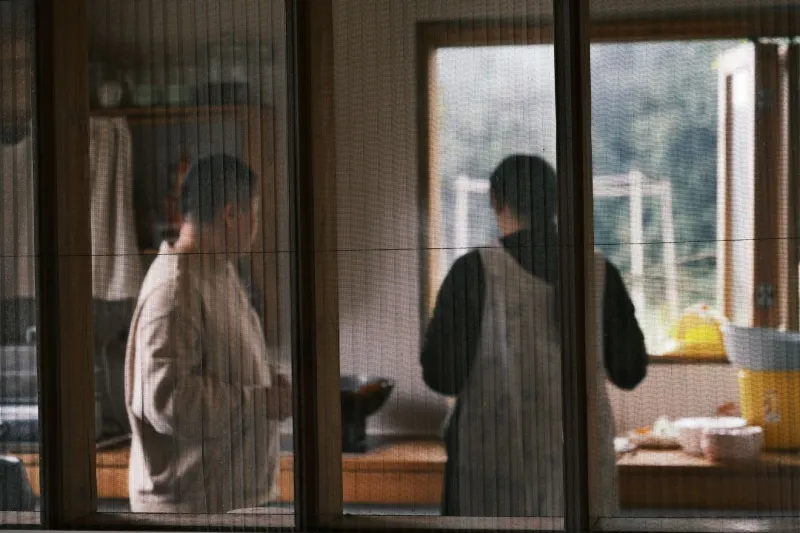
Hitozuma content is notable for the consistency with which it deploys domestic settings — kitchens, living rooms, ordinary suburban interiors that would not look out of place in a midwestern American home. This is not incidental production design. The domestic frame functions as an emotional amplifier, grounding the fantasy in recognizable, even mundane, geography.
For American viewers, this ordinariness serves a specific purpose. It positions the hitozuma not as an exotic fantasy figure but as a plausible presence — someone who could, in theory, exist in proximity to their own lives. The fantasy is not set in an unreachable elsewhere; it is set in a version of the everyday, which makes the desire it depicts feel simultaneously more transgressive and more real.
Japanese adult content producers have long understood that the power of this setting lies precisely in its banality. The extraordinary event — the encounter, the disclosure of desire, the unfolding intimacy — is made more affecting by the ordinariness of its backdrop. American audiences, accustomed to the highly stylized production environments of domestic adult content, often find this contrast striking. The hitozuma's world looks lived-in because it is meant to.
What the Fascination Reveals
The growing American appetite for hitozuma content does not reflect a simple desire for infidelity narratives repackaged with Japanese aesthetics. It reflects something more nuanced: a hunger for adult content that takes interiority seriously, that treats desire as something that accumulates rather than merely erupts, and that positions the woman at its center as a full subject rather than a passive object.
In this sense, the hitozuma fantasy tells us less about American men's attitudes toward marriage than it does about their dissatisfaction with the emotional shallowness of most available adult content. The married woman archetype, with its built-in weight of consequence and its emphasis on genuine longing, offers a fantasy that feels, against all structural odds, emotionally credible.
That credibility — earned through restraint, context, and the careful construction of desire as something that means something — may be the most powerful thing the hitozuma genre has to offer Western audiences. And it is, notably, something that the American adult entertainment industry has shown remarkably little interest in learning to replicate.