The Virtue of the Unpolished: How Japanese Adult Cinema's Aesthetic Honesty Disarms the American Viewer
There is a particular kind of exhaustion that settles over a viewer accustomed to American adult entertainment. It is not the exhaustion of overstimulation, precisely, but something more like the fatigue that follows a meal composed entirely of processed ingredients—technically satisfying, nutritionally hollow. The lighting is always calibrated. The settings are always aspirational. The performers move with the confidence of people who have been told, repeatedly, that they are exceptional. Nothing is out of place. Nothing, consequently, feels entirely true.
Japanese adult cinema, particularly within the hitozuma tradition, operates from a fundamentally different set of assumptions about what a viewer actually wants—and, more pointedly, what a viewer actually needs.
Imperfection as Intentional Grammar
To describe Japanese adult production as less polished than its American counterpart would be technically accurate but critically misleading. The distinction is not one of budget or capability; it is one of philosophy. Where American producers treat the removal of imperfection as an unambiguous good, Japanese producers have long understood that imperfection carries semantic weight. A slightly asymmetrical setting, a performer whose hair is not quite camera-ready, a domestic space that bears the unmistakable evidence of being actually lived in—these are not oversights. They are sentences in a visual language that communicates, above all else, this is real.
The psychological literature on authenticity in media consumption offers a useful framework here. Researchers studying what is sometimes called the "uncanny valley of perfection" have noted that hyper-idealized representations can paradoxically create emotional distance in viewers. When every surface is flawless, the viewer's brain registers the artifice and retreats behind a kind of aesthetic glass—appreciating the image without being moved by it. Japanese adult cinema, by contrast, tends to locate its viewer inside the scene rather than in front of it. The imperfections are the invitation.
The Domestic as Documentary
This aesthetic philosophy becomes most legible in the genre's treatment of domestic space. American adult productions, when they venture into home settings, tend toward the aspirational: open-plan kitchens with granite countertops, bedrooms that suggest a decorator's intervention. The home is a backdrop, and a flattering one.
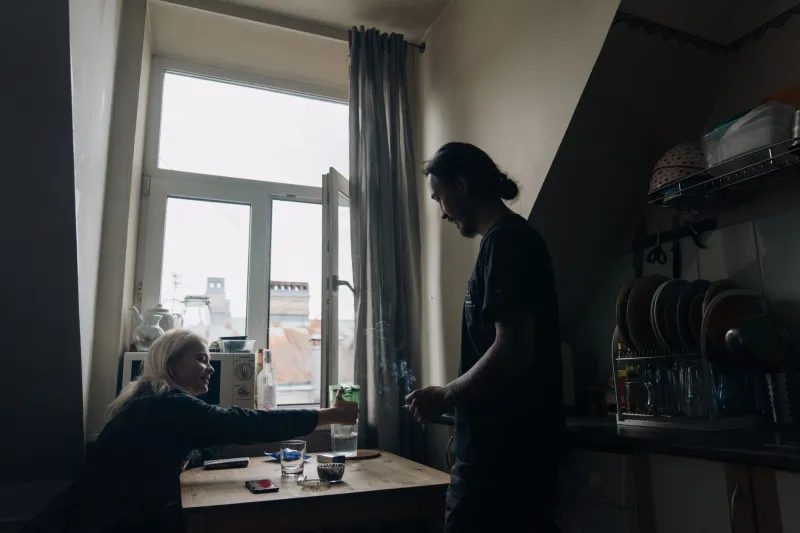
In hitozuma content, the home is something closer to a document. Ordinary curtains. Familiar clutter. The particular quality of afternoon light through a window that has not been dressed for a camera. These details accumulate into a portrait of a life actually being lived, and it is within that portrait that the erotic content finds its peculiar power. The intimacy feels discovered rather than staged—and that distinction, for a significant portion of American viewers, is the entire difference between engagement and detachment.
This is not accidental. Japanese producers working within this tradition have spoken, in industry contexts, about the deliberate cultivation of what might be translated as nichijō-sei—a quality of everyday-ness, of the unremarkable made present. The goal is not realism for its own sake but realism as a delivery mechanism for emotional proximity.
Performance Without the Performance
The same logic extends to the performers themselves. American adult entertainment has long operated within a star system that emphasizes exceptionalism: the performers are beautiful in ways that are explicitly extraordinary, their confidence is theatrical, their presence is designed to communicate fantasy rather than familiarity. This is a coherent aesthetic choice, and it serves a particular audience appetite.
The hitozuma tradition addresses a different appetite entirely. The women at its center are frequently presented not as exceptions to ordinary life but as expressions of it. Their appeal is constructed around recognizability rather than distance. A viewer is not meant to marvel at them from afar; he is meant to feel, however irrationally, that the distance between his world and theirs is negotiable.
This requires a specific quality of performance—one that resists the polished confidence of the professional and leans instead toward something more tentative, more particular, more human. The unrehearsed moment that gives this piece its title is not a gaffe; it is, in the best instances of the genre, the entire point. When a performer's response to a situation reads as genuinely felt rather than technically executed, the viewer's emotional investment shifts from passive to participatory. He is no longer watching a fantasy; he is, in some meaningful psychological sense, present within one.
What American Audiences Are Actually Escaping
To understand why this aesthetic philosophy resonates with American viewers requires a brief accounting of what those viewers are escaping when they seek out Japanese adult content. The United States is, at this cultural moment, a society in which nearly every form of entertainment has been subjected to intensive optimization. Streaming algorithms surface content calibrated to retain attention. Social media presents human lives through filters that have become so ubiquitous as to constitute a new visual vernacular. Even the most intimate forms of self-presentation have been colonized by the logic of the highlight reel.
In this context, the deliberate roughness of Japanese adult cinema functions as something closer to relief than novelty. It is not that American viewers have developed a sudden aesthetic preference for the unpolished; it is that the unpolished has come to signify something the polished cannot: the possibility that what they are watching is, in some meaningful sense, true.
This is the deeper cultural work that the hitozuma tradition performs for its Western audience. It does not simply offer an alternative fantasy; it offers an alternative epistemology of the intimate—a way of knowing desire that prioritizes texture over gloss, proximity over spectacle, the particular over the ideal.
The Paradox at the Center
There is a productive paradox embedded in all of this. Japanese adult cinema, working within significant regulatory constraints and with production budgets that rarely approach American industry standards, has arrived at an aesthetic that many American viewers experience as more sophisticated, more emotionally resonant, and more genuinely pleasurable than the lavishly produced content their own industry generates. The constraint, it turns out, was never the limitation; the aspiration toward perfection was.
For the audience that Hitozuma Realm serves—viewers who have moved beyond the surface satisfactions of mainstream Western production and found themselves drawn to something more nuanced—this paradox is not merely an intellectual curiosity. It is the explanation for a preference they may have felt but struggled to articulate. The unpolished image is not the inferior image. In the hands of producers who understand what authenticity actually costs, and what it actually delivers, it is frequently the more powerful one.
The unrehearsed moment, it turns out, is the one that stays with you.